








The only agent that thinks for itself

Autonomous Monitoring with self-learning AI built-in, operating independently across your entire stack.

Unlimited Metrics & Logs
Machine learning & MCP
5% CPU, 150MB RAM
3GB disk, >1 year retention
800+ integrations, zero config
Dashboards, alerts out of the box
> Discover Netdata Agents

Centralized metrics streaming and storage

Aggregate metrics from multiple agents into centralized Parent nodes for unified monitoring across your infrastructure.

Stream from unlimited agents
Long-term data retention
High availability clustering
Data replication & backup
Scalable architecture
Enterprise-grade security
> Learn about Parents

Fully managed cloud platform

Access your monitoring data from anywhere with our SaaS platform. No infrastructure to manage, automatic updates, and global availability.

Zero infrastructure management
99.9% uptime SLA
Global data centers
Automatic updates & patches
Enterprise SSO & RBAC
SOC2 & ISO certified
> Explore Netdata Cloud

Deploy Netdata Cloud in your infrastructure

Run the full Netdata Cloud platform on-premises for complete data sovereignty and compliance with your security policies.

Complete data sovereignty
Air-gapped deployment
Custom compliance controls
Private network integration
Dedicated support team
Kubernetes & Docker support
> Learn about Cloud On-Premises

Powerful, intuitive monitoring interface

Modern, responsive UI built for real-time troubleshooting with customizable dashboards and advanced visualization capabilities.

Real-time chart updates
Customizable dashboards
Dark & light themes
Advanced filtering & search
Responsive on all devices
Collaboration features
> Explore Netdata UI

Monitor on the go

Native iOS and Android apps bring full monitoring capabilities to your mobile device with real-time alerts and notifications.

iOS & Android apps
Push notifications
Touch-optimized interface
Offline data access
Biometric authentication
Widget support
> Download apps

The future of infrastructure observability

See our strategic direction across AI-native observability, full-stack signals, operational intelligence, and enterprise platform maturity.

AI-native observability
Full-stack signal coverage
Operational intelligence
Enterprise platform maturity
Agent releases every 6 weeks
Cloud continuous delivery
> Explore Product Roadmap

Best energy efficiency

True real-time per-second

100% automated zero config

Centralized observability

Multi-year retention

High availability built-in

Zero maintenance

Always up-to-date

Enterprise security

Complete data control

Air-gap ready

Compliance certified

Millisecond responsiveness

Infinite zoom & pan

Works on any device

Native performance

Instant alerts

Monitor anywhere

AI-native observability

Continuous delivery

Open source foundation

80% Faster Incident Resolution

AI-powered troubleshooting from detection, to root cause and blast radius identification, to reporting.

True Real-Time and Simple, even at Scale

Linearly and infinitely scalable full-stack observability, that can be deployed even mid-crisis.

90% Cost Reduction, Full Fidelity

Instead of centralizing the data, Netdata distributes the code, eliminating pipelines and complexity.

Control Without Surrender

SOC 2 Type 2 certified with every metric kept on your infrastructure.

Integrations

800+ collectors and notification channels, auto-discovered and ready out of the box.

800+ data collectors
Auto-discovery & zero config
Cloud, infra, app protocols
Notifications out of the box
> Explore integrations
Real Results
46% Cost Reduction

Reduced monitoring costs by 46% while cutting staff overhead by 67%.

— Leonardo Antunez, Codyas

Zero Pipeline

No data shipping. No central storage costs. Query at the edge.

From Our Users
"Out-of-the-Box"

So many out-of-the-box features! I mostly don't have to develop anything.

— Simon Beginn, LANCOM Systems

No Query Language

Point-and-click troubleshooting. No PromQL, no LogQL, no learning curve.

Enterprise Ready
67% Less Staff, 46% Cost Cut

Enterprise efficiency without enterprise complexity—real ROI from day one.

— Leonardo Antunez, Codyas

SOC 2 Type 2 Certified

Zero data egress. Only metadata reaches the cloud. Your metrics stay on your infrastructure.

Full Coverage
800+ Collectors

Auto-discovered and configured. No manual setup required.

Any Notification Channel

Slack, PagerDuty, Teams, email, webhooks—all built-in.

Built for the People Who Get Paged

Because 3am alerts deserve instant answers, not hour-long hunts.

Every Industry Has Rules. We Master Them.

See how healthcare, finance, and government teams cut monitoring costs 90% while staying audit-ready.

Monitor Any Technology. Configure Nothing.

Install the agent. It already knows your stack.
From Our Users
"A Rare Unicorn"

Netdata gives more than you invest in it. A rare unicorn that obeys the Pareto rule.

— Eduard Porquet Mateu, TMB Barcelona

99% Downtime Reduction

Reduced website downtime by 99% and cloud bill by 30% using Netdata alerts.

— Falkland Islands Government

Real Savings
30% Cloud Cost Reduction

Optimized resource allocation based on Netdata alerts cut cloud spending by 30%.

— Falkland Islands Government

46% Cost Cut

Reduced monitoring staff by 67% while cutting operational costs by 46%.

— Codyas

Real Coverage
"Plugin for Everything"

Netdata has agent capacity or a plugin for everything, including Windows and Kubernetes.

— Eduard Porquet Mateu, TMB Barcelona

"Out-of-the-Box"

So many out-of-the-box features! I mostly don't have to develop anything.

— Simon Beginn, LANCOM Systems

Real Speed
Troubleshooting in 30 Seconds

From 2-3 minutes to 30 seconds—instant visibility into any node issue.

— Matthew Artist, Nodecraft

20% Downtime Reduction

20% less downtime and 40% budget optimization from out-of-the-box monitoring.

— Simon Beginn, LANCOM Systems

Pay per Node. Unlimited Everything Else.

One price per node. Unlimited metrics, logs, users, and retention. No per-GB surprises.

Free tier—forever
No metric limits or caps
Retention you control
Cancel anytime
> See pricing plans

What's Your Monitoring Really Costing You?

Most teams overpay by 40-60%. Let's find out why.

Expose hidden metric charges
Calculate tool consolidation
Customers report 30-67% savings
Results in under 60 seconds
> See what you're really paying

Your Infrastructure Is Unique. Let's Talk.

Because monitoring 10 nodes is different from monitoring 10,000.

On-prem & air-gapped deployment
Volume pricing & agreements
Architecture review for your scale
Compliance & security support
> Start a conversation

Monitoring That Sells Itself

Deploy in minutes. Impress clients in hours. Earn recurring revenue for years.

30-second live demos close deals
Zero config = zero support burden
Competitive margins & deal protection
Response in 48 hours
> Apply to partner

Per-Second Metrics at Homelab Prices

Same engine, same dashboards, same ML. Just priced for tinkerers.

Community: Free forever · 5 nodes · non-commercial
Homelab: $90/yr · unlimited nodes · fair usage
> Get the Homelab Plan

$1,000 Per Referral. Unlimited Referrals.

Your colleagues get 10% off. You get 10% commission. Everyone wins.

10% of subscriptions, up to $1,000 each
Track earnings inside Netdata Cloud
PayPal/Venmo payouts in 3-4 weeks
No caps, no complexity
> Get your referral link
Cost Proof
40% Budget Optimization

"Netdata's significant positive impact" — LANCOM Systems

Calculate Your Savings

Compare vs Datadog, Grafana, Dynatrace

Savings Proof
46% Cost Reduction

"Cut costs by 46%, staff by 67%" — Codyas

30% Cloud Bill Savings

"Reduced cloud bill by 30%" — Falkland Islands Gov

Enterprise Proof
"Better Than Combined Alternatives"

"Better observability with Netdata than combining other tools." — TMB Barcelona

Real Engineers, <24h Response

DPA, SLAs, on-prem, volume pricing

Why Partners Win
Demo Live Infrastructure

One command, 30 seconds, real data—no sandbox needed

Zero Tickets, High Margins

Auto-config + per-node pricing = predictable profit

Homelab Ready
Free Video Course

8-episode Netdata tutorial by LearnLinux.tv

76k+ GitHub Stars

3rd most starred monitoring project

Worth Recommending
Product That Delivers

Customers report 40-67% cost cuts, 99% downtime reduction

Zero Risk to Your Rep

Free tier lets them try before they buy

AI Support Assistant, Available 24/7

Nedi has access to all official documentation, source code, and resources. Ask any question about Netdata—responds in your language.

Deployment & configuration
Troubleshooting & sizing
Alerts & notifications
Evidence-based answers
> Ask Nedi now

Never Fight Fires Alone

Docs, community, and expert help—pick your path to resolution.

Learn.netdata.cloud docs
Discord, Forums, GitHub
Premium support available
> Get answers now

60 Seconds to First Dashboard

One command to install. Zero config. 850+ integrations documented.

Linux, Windows, K8s, Docker
Auto-discovers your stack
> Read our documentation

Level Up Your Monitoring

Real problems. Real solutions. 112+ guides from basic monitoring to AI observability.

76,000+ Engineers Strong

615+ contributors. 1.5M daily downloads. One mission: simplify observability.

Per-Second. 90% Cheaper. Data Stays Home.

Side-by-side comparisons: costs, real-time granularity, and data sovereignty for every major tool.

See why teams switch from Datadog, Prometheus, Grafana, and more.

> Browse all comparisons
Edge-Native Observability, Born Open Source
Per-second visibility, ML on every metric, and data that never leaves your infrastructure.
Founded in 2016
615+ contributors worldwide
Remote-first, engineering-driven
Open source first
> Read our story
Promises We Publish—and Prove
12 principles backed by open code, independent validation, and measurable outcomes.
Open source, peer-reviewed
Zero config, instant value
Data sovereignty by design
Aligned pricing, no surprises
> See all 12 principles
Edge-Native, AI-Ready, 100% Open
76k+ stars. Full ML, AI, and automation—GPLv3+, not premium add-ons.
76,000+ GitHub stars
GPLv3+ licensed forever
ML on every metric, included
Zero vendor lock-in
> Explore our open source
Build Real-Time Observability for the World
Remote-first team shipping per-second monitoring with ML on every metric.
Remote-first, fully distributed
Open source (76k+ stars)
Challenging technical problems
Your code on millions of systems
> See open roles
Meet the Team Behind Netdata
Conferences, meetups, and tradeshows where you can see Netdata in action and talk to the engineers who build it.
Live demos and deep dives
Book 1-on-1 meetings
Talks and panel sessions
Event recaps and photos
> See all events
Talk to a Netdata Human in <24 Hours
Sales, partnerships, press, or professional services—real engineers, fast answers.
Discuss your observability needs
Pricing and volume discounts
Partnership opportunities
Media and press inquiries
> Book a conversation
Your Data. Your Rules.
On-prem data, cloud control plane, transparent terms.
Trust & Scale
76,000+ GitHub Stars

One of the most popular open-source monitoring projects

SOC 2 Type 2 Certified

Enterprise-grade security and compliance

Data Sovereignty

Your metrics stay on your infrastructure

Validated
University of Amsterdam

"Most energy-efficient monitoring solution" — ICSOC 2023, peer-reviewed

ADASTEC (Autonomous Driving)

"Doesn't miss alerts—mission-critical trust for safety software"

Community Stats
615+ Contributors

Global community improving monitoring for everyone

1.5M+ Downloads/Day

Trusted by teams worldwide

GPLv3+ Licensed

Free forever, fully open source agent

Why Join?
Remote-First

Work from anywhere, async-friendly culture

Impact at Scale

Your work helps millions of systems

Blog

Monitoring Your Azure to Azure Local Migration: One Dashboard for Both Sides

Monitor both sides of your migration in a single pane. Azure cloud metrics and Azure Local infrastructure, together.
by Satyadeep Ashwathnarayana · May 11, 2026

Monitoring Your Azure to Azure Local Migration: One Dashboard for Both Sides

More organizations are moving workloads from Azure public cloud to Azure Local (formerly Azure Stack HCI) than most people realize. The reasons vary: data sovereignty requirements, latency-sensitive workloads that need to be closer to the edge, cost optimization for predictable workloads where reserved cloud capacity doesn’t make financial sense, or regulatory constraints that require data to stay on-premises.

Whatever the driver, the migration itself creates a monitoring challenge. During the transition, you’re running workloads in two places simultaneously. Your source environment in Azure needs to stay healthy while you migrate. Your target Azure Local infrastructure needs to be validated before, during, and after workloads land. And once migration is complete, you need ongoing monitoring of your new on-prem environment with the same depth you had in the cloud.

Netdata covers all of this natively.

The monitoring gap during migration

Most migrations go through a period where workloads exist in both environments. You might be running your production database in Azure while standing up the replacement on Azure Local. Or you’re migrating VMs in waves, with some services still hitting Azure endpoints and others already running on-prem.

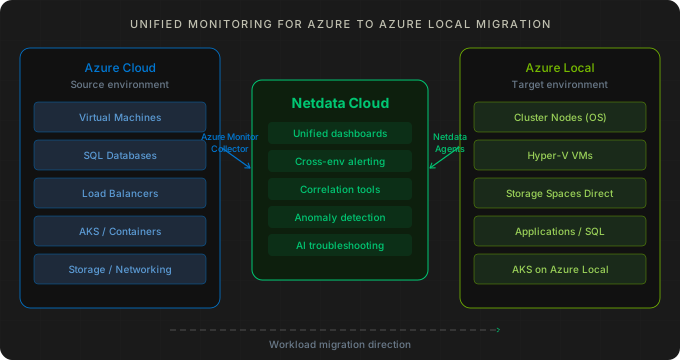
During this period, the teams managing the migration need a unified view. They need to see Azure cloud resource health (VM performance, SQL database DTU consumption, load balancer metrics) alongside Azure Local infrastructure health (Hyper-V host performance, Storage Spaces Direct status, network throughput, VM workloads on the new cluster) in the same dashboard, with the same alerting, and with the same timeline.

If your monitoring is split between Azure Monitor on one side and a separate tool on the other, you’re constantly switching context during the most critical phase of the project.

How Netdata covers both sides

Azure cloud resources are monitored through Netdata’s Azure Monitor collector (docs). It connects to the Azure Monitor Metrics API, automatically discovers your resources across subscriptions, and collects platform metrics using built-in service profiles. VMs, SQL databases, load balancers, AKS clusters, storage accounts, and more are covered out of the box.

Azure Local infrastructure is monitored through standard Netdata agents installed on your Azure Local cluster nodes. The agents collect OS-level metrics (CPU, memory, disk, network), Hyper-V metrics for hosted VMs, Storage Spaces Direct health and performance, and application-level metrics for whatever services are running on your workloads. Because Netdata agents are lightweight (typically under 1% CPU overhead), they don’t compete with your workloads for resources on hardware that’s already sized for production.

Both land in the same Netdata Cloud dashboard. Your Azure cloud resources and your Azure Local nodes appear together. You can build custom dashboards that show source and destination side by side. You can set up alerts that watch both environments. Netdata’s correlation tools work across all your nodes regardless of where they’re running.

Before migration: baseline and validate

Before you move a single workload, you want to establish baselines on both sides. On the Azure side, Netdata captures the performance characteristics of the workloads you’re about to migrate: how much CPU and memory they consume, their I/O patterns, their network throughput. These baselines become your success criteria after migration.

On the Azure Local side, you want to validate that your new infrastructure is healthy before it takes production load. Netdata agents on the cluster nodes give you immediate visibility into hardware health, storage pool status, network configuration, and whether the environment is performing as expected under synthetic load.

During migration: parallel visibility

This is where unified monitoring matters most. As you migrate workloads in waves, you need to watch both the source (to make sure remaining workloads aren’t impacted) and the destination (to validate that migrated workloads are performing correctly).

Netdata lets you compare the same workload running on Azure against its counterpart on Azure Local. Is the SQL database performing the same after migration? Are response times comparable? Has disk I/O changed? Because both data sources are in the same system with the same timeline, these comparisons are straightforward.

If something goes wrong during cutover, you have the data to decide quickly: roll back or push forward.

After migration: ongoing operations

Once migration is complete, your Netdata deployment transitions naturally from a migration tool to your ongoing monitoring solution for the Azure Local environment. The agents are already installed. The dashboards are already built. The alerts are already configured. You don’t need to set up a new monitoring stack for your on-prem infrastructure.

For workloads that remain in Azure (or for hybrid architectures where some services stay in the cloud), the Azure Monitor collector continues to run alongside your Azure Local monitoring. The unified view persists as long as you need it.

Deployment architecture on Azure Local

The deployment pattern is simple and symmetric:
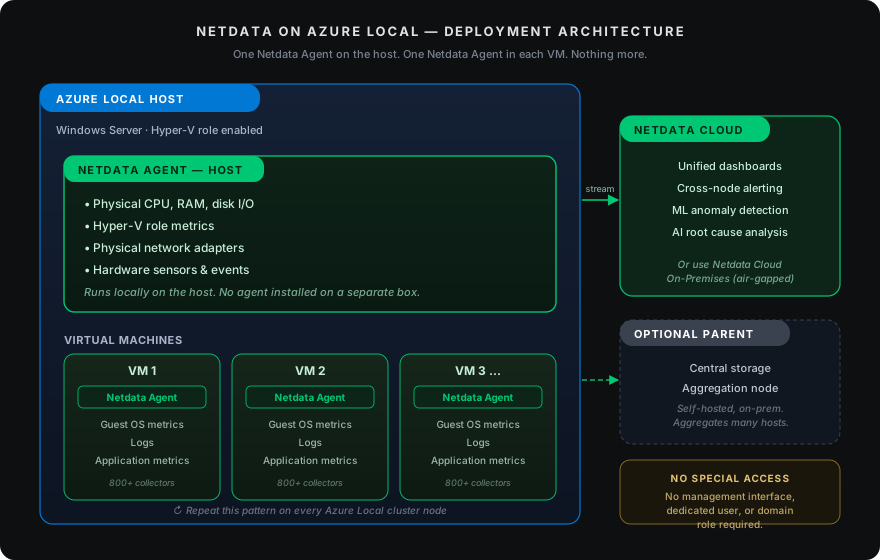
Netdata deployment architecture on Azure Local: agents on each host and each VM, optional Parent for central storage

Netdata Agent on every Azure Local host (Windows Server with the Hyper-V role) collects:

  • All host-level metrics and logs
  • Physical CPU, RAM, and disk I/O
  • Hyper-V role metrics
  • Physical network adapters
  • Hardware sensors and events (temperature, fans, power, controllers)

Netdata Agent on every Azure Local VM collects:

  • Guest OS metrics and logs
  • Application-level metrics through Netdata’s 800+ collectors

Combined, you get complete visibility of your Azure Local infrastructure — from hardware sensors on the host all the way up through every guest workload running on top.

One important detail: no special access is required. You don’t need to open up any management interface, create dedicated monitoring users, or grant domain roles to collect anything described here. The agents run locally on each system and report metrics to Netdata Cloud directly (or, if you prefer central storage and aggregation on-prem, to an optional Netdata Parent).

If you want to dive into setup right away, the relevant Netdata Learn pages are: installing the agent on Windows, Windows machine monitoring, Windows Event Logs, and the Azure Monitor collector.

What gets monitored on Azure Local

A non-exhaustive list of what Netdata covers out of the box on Azure Local cluster nodes:

The host operating system gets full metric coverage: CPU utilization per core, memory usage and pressure, disk I/O and latency per device, network throughput and errors per interface, and hundreds of other OS metrics at per-second granularity.

Hyper-V virtual machines running on the cluster are monitored through Netdata’s Hyper-V collector, giving you per-VM resource consumption alongside host-level metrics.

Storage Spaces Direct health, performance, and capacity metrics are collected from the cluster, which is critical for Azure Local since storage performance directly impacts all hosted workloads.

Any applications running on the workloads (SQL Server, web servers, containers, custom applications) are monitored through Netdata’s 800+ collector integrations. If you’re running the same applications you had in Azure, the monitoring coverage carries over.

Everything gets Netdata’s anomaly detection automatically. Unusual patterns in any metric are flagged without configuration, which is particularly useful in the post-migration period when you’re still establishing what “normal” looks like on the new infrastructure.

Talk to us

If you’re planning or currently executing an Azure to Azure Local migration and want to see how Netdata fits into your monitoring strategy, we’d like to hear from you. We’re working with several organizations going through this exact transition and can share what’s worked well.

Learn more about Netdata for Azure to Azure Local migrations →

Get in touch →

Or try Netdata today →