









The only agent that thinks for itself

Autonomous Monitoring with self-learning AI built-in, operating independently across your entire stack.

Unlimited Metrics & Logs
Machine learning & MCP
5% CPU, 150MB RAM
3GB disk, >1 year retention
800+ integrations, zero config
Dashboards, alerts out of the box
> Discover Netdata Agents
Centralized metrics streaming and storage

Aggregate metrics from multiple agents into centralized Parent nodes for unified monitoring across your infrastructure.

Stream from unlimited agents
Long-term data retention
High availability clustering
Data replication & backup
Scalable architecture
Enterprise-grade security
> Learn about Parents
Fully managed cloud platform

Access your monitoring data from anywhere with our SaaS platform. No infrastructure to manage, automatic updates, and global availability.

Zero infrastructure management
99.9% uptime SLA
Global data centers
Automatic updates & patches
Enterprise SSO & RBAC
SOC2 & ISO certified
> Explore Netdata Cloud
Deploy Netdata Cloud in your infrastructure

Run the full Netdata Cloud platform on-premises for complete data sovereignty and compliance with your security policies.

Complete data sovereignty
Air-gapped deployment
Custom compliance controls
Private network integration
Dedicated support team
Kubernetes & Docker support
> Learn about Cloud On-Premises
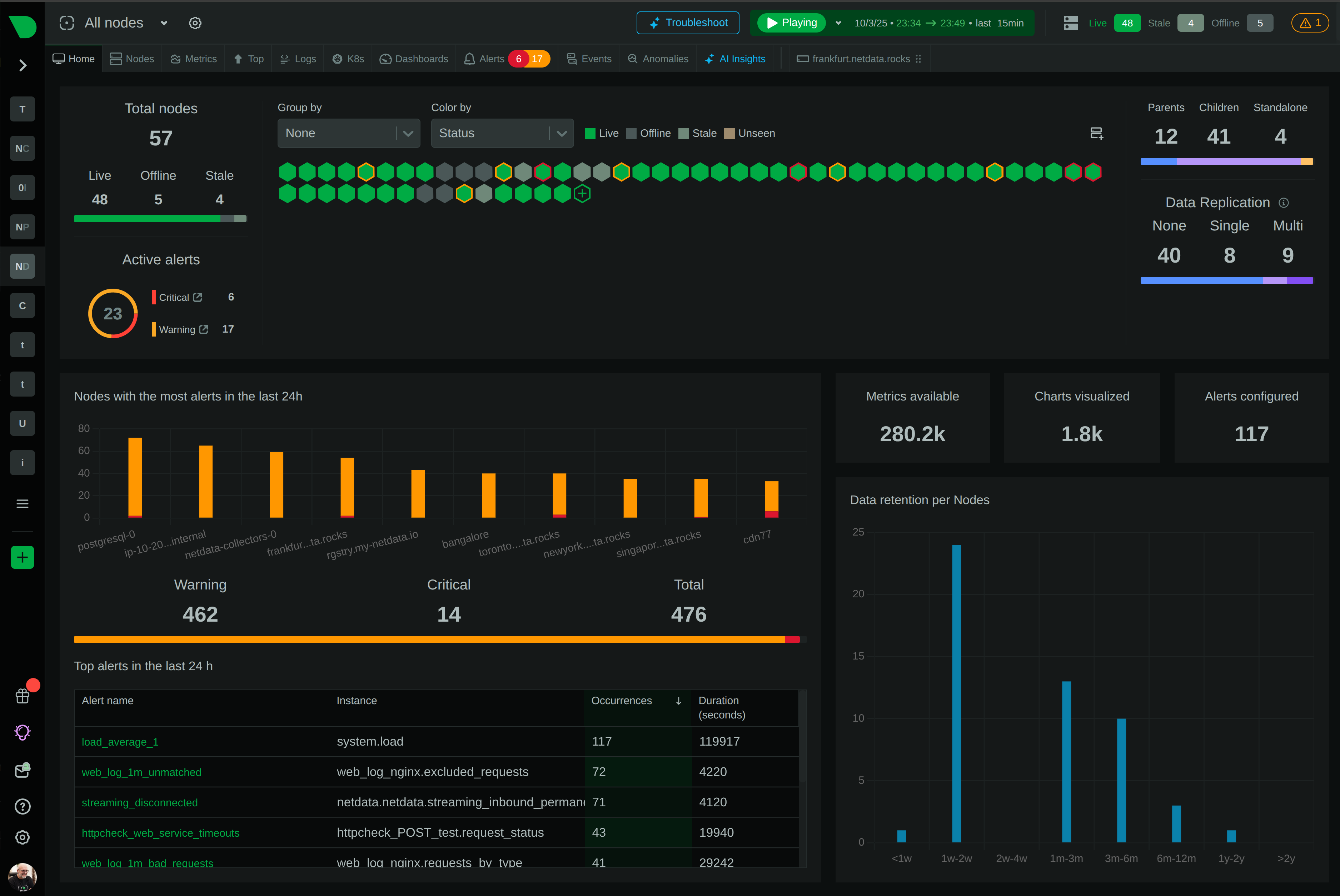
Powerful, intuitive monitoring interface

Modern, responsive UI built for real-time troubleshooting with customizable dashboards and advanced visualization capabilities.

Real-time chart updates
Customizable dashboards
Dark & light themes
Advanced filtering & search
Responsive on all devices
Collaboration features
> Explore Netdata UI
Monitor on the go

Native iOS and Android apps bring full monitoring capabilities to your mobile device with real-time alerts and notifications.

iOS & Android apps
Push notifications
Touch-optimized interface
Offline data access
Biometric authentication
Widget support
> Download apps

Best energy efficiency

True real-time per-second

100% automated zero config

Centralized observability

Multi-year retention

High availability built-in

Zero maintenance

Always up-to-date

Enterprise security

Complete data control

Air-gap ready

Compliance certified

Millisecond responsiveness

Infinite zoom & pan

Works on any device

Native performance

Instant alerts

Monitor anywhere

80% Faster Incident Resolution
AI-powered troubleshooting from detection, to root cause and blast radius identification, to reporting.
True Real-Time and Simple, even at Scale
Linearly and infinitely scalable full-stack observability, that can be deployed even mid-crisis.
90% Cost Reduction, Full Fidelity
Instead of centralizing the data, Netdata distributes the code, eliminating pipelines and complexity.
Control Without Surrender
SOC 2 Type 2 certified with every metric kept on your infrastructure.
Integrations

800+ collectors and notification channels, auto-discovered and ready out of the box.

800+ data collectors
Auto-discovery & zero config
Cloud, infra, app protocols
Notifications out of the box
> Explore integrations
Real Results
46% Cost Reduction

Reduced monitoring costs by 46% while cutting staff overhead by 67%.

— Leonardo Antunez, Codyas

Zero Pipeline

No data shipping. No central storage costs. Query at the edge.

From Our Users
"Out-of-the-Box"

So many out-of-the-box features! I mostly don't have to develop anything.

— Simon Beginn, LANCOM Systems

No Query Language

Point-and-click troubleshooting. No PromQL, no LogQL, no learning curve.

Enterprise Ready
67% Less Staff, 46% Cost Cut

Enterprise efficiency without enterprise complexity—real ROI from day one.

— Leonardo Antunez, Codyas

SOC 2 Type 2 Certified

Zero data egress. Only metadata reaches the cloud. Your metrics stay on your infrastructure.

Full Coverage
800+ Collectors

Auto-discovered and configured. No manual setup required.

Any Notification Channel

Slack, PagerDuty, Teams, email, webhooks—all built-in.

Built for the People Who Get Paged
Because 3am alerts deserve instant answers, not hour-long hunts.
Every Industry Has Rules. We Master Them.
See how healthcare, finance, and government teams cut monitoring costs 90% while staying audit-ready.
Monitor Any Technology. Configure Nothing.
Install the agent. It already knows your stack.
From Our Users
"A Rare Unicorn"

Netdata gives more than you invest in it. A rare unicorn that obeys the Pareto rule.

— Eduard Porquet Mateu, TMB Barcelona

99% Downtime Reduction

Reduced website downtime by 99% and cloud bill by 30% using Netdata alerts.

— Falkland Islands Government

Real Savings
30% Cloud Cost Reduction

Optimized resource allocation based on Netdata alerts cut cloud spending by 30%.

— Falkland Islands Government

46% Cost Cut

Reduced monitoring staff by 67% while cutting operational costs by 46%.

— Codyas

Real Coverage
"Plugin for Everything"

Netdata has agent capacity or a plugin for everything, including Windows and Kubernetes.

— Eduard Porquet Mateu, TMB Barcelona

"Out-of-the-Box"

So many out-of-the-box features! I mostly don't have to develop anything.

— Simon Beginn, LANCOM Systems

Real Speed
Troubleshooting in 30 Seconds

From 2-3 minutes to 30 seconds—instant visibility into any node issue.

— Matthew Artist, Nodecraft

20% Downtime Reduction

20% less downtime and 40% budget optimization from out-of-the-box monitoring.

— Simon Beginn, LANCOM Systems

Pay per Node. Unlimited Everything Else.

One price per node. Unlimited metrics, logs, users, and retention. No per-GB surprises.

Free tier—forever
No metric limits or caps
Retention you control
Cancel anytime
> See pricing plans
What's Your Monitoring Really Costing You?

Most teams overpay by 40-60%. Let's find out why.

Expose hidden metric charges
Calculate tool consolidation
Customers report 30-67% savings
Results in under 60 seconds
> See what you're really paying
Your Infrastructure Is Unique. Let's Talk.

Because monitoring 10 nodes is different from monitoring 10,000.

On-prem & air-gapped deployment
Volume pricing & agreements
Architecture review for your scale
Compliance & security support
> Start a conversation
Monitoring That Sells Itself

Deploy in minutes. Impress clients in hours. Earn recurring revenue for years.

30-second live demos close deals
Zero config = zero support burden
Competitive margins & deal protection
Response in 48 hours
> Apply to partner
Per-Second Metrics at Homelab Prices

Same engine, same dashboards, same ML. Just priced for tinkerers.

Community: Free forever · 5 nodes · non-commercial
Homelab: $90/yr · unlimited nodes · fair usage
> Start monitoring your lab—free
$1,000 Per Referral. Unlimited Referrals.

Your colleagues get 10% off. You get 10% commission. Everyone wins.

10% of subscriptions, up to $1,000 each
Track earnings inside Netdata Cloud
PayPal/Venmo payouts in 3-4 weeks
No caps, no complexity
> Get your referral link
Cost Proof
40% Budget Optimization

"Netdata's significant positive impact" — LANCOM Systems

Calculate Your Savings

Compare vs Datadog, Grafana, Dynatrace

Savings Proof
46% Cost Reduction

"Cut costs by 46%, staff by 67%" — Codyas

30% Cloud Bill Savings

"Reduced cloud bill by 30%" — Falkland Islands Gov

Enterprise Proof
"Better Than Combined Alternatives"

"Better observability with Netdata than combining other tools." — TMB Barcelona

Real Engineers, <24h Response

DPA, SLAs, on-prem, volume pricing

Why Partners Win
Demo Live Infrastructure

One command, 30 seconds, real data—no sandbox needed

Zero Tickets, High Margins

Auto-config + per-node pricing = predictable profit

Homelab Ready
"Absolutely Incredible"

"We tested every monitoring system under the sun." — Benjamin Gabler, CEO Rocket.Net

76k+ GitHub Stars

3rd most starred monitoring project

Worth Recommending
Product That Delivers

Customers report 40-67% cost cuts, 99% downtime reduction

Zero Risk to Your Rep

Free tier lets them try before they buy

Never Fight Fires Alone

Docs, community, and expert help—pick your path to resolution.

Learn.netdata.cloud docs
Discord, Forums, GitHub
Premium support available
> Get answers now
60 Seconds to First Dashboard

One command to install. Zero config. 850+ integrations documented.

Linux, Windows, K8s, Docker
Auto-discovers your stack
> Read our documentation
See Netdata in Action

Watch real-time monitoring in action—demos, tutorials, and engineering deep dives.

Product demos and walkthroughs
Real infrastructure, not staged
> Start with the 3-minute tour
Level Up Your Monitoring
Real problems. Real solutions. 112+ guides from basic monitoring to AI observability.
76,000+ Engineers Strong
615+ contributors. 1.5M daily downloads. One mission: simplify observability.
Per-Second. 90% Cheaper. Data Stays Home.
Side-by-side comparisons: costs, real-time granularity, and data sovereignty for every major tool.

See why teams switch from Datadog, Prometheus, Grafana, and more.

> Browse all comparisons
Edge-Native Observability, Born Open Source
Per-second visibility, ML on every metric, and data that never leaves your infrastructure.
Founded in 2016
615+ contributors worldwide
Remote-first, engineering-driven
Open source first
> Read our story
Promises We Publish—and Prove
12 principles backed by open code, independent validation, and measurable outcomes.
Open source, peer-reviewed
Zero config, instant value
Data sovereignty by design
Aligned pricing, no surprises
> See all 12 principles
Edge-Native, AI-Ready, 100% Open
76k+ stars. Full ML, AI, and automation—GPLv3+, not premium add-ons.
76,000+ GitHub stars
GPLv3+ licensed forever
ML on every metric, included
Zero vendor lock-in
> Explore our open source
Build Real-Time Observability for the World
Remote-first team shipping per-second monitoring with ML on every metric.
Remote-first, fully distributed
Open source (76k+ stars)
Challenging technical problems
Your code on millions of systems
> See open roles
Talk to a Netdata Human in <24 Hours
Sales, partnerships, press, or professional services—real engineers, fast answers.
Discuss your observability needs
Pricing and volume discounts
Partnership opportunities
Media and press inquiries
> Book a conversation
Your Data. Your Rules.
On-prem data, cloud control plane, transparent terms.
Trust & Scale
76,000+ GitHub Stars

One of the most popular open-source monitoring projects

SOC 2 Type 2 Certified

Enterprise-grade security and compliance

Data Sovereignty

Your metrics stay on your infrastructure

Validated
University of Amsterdam

"Most energy-efficient monitoring solution" — ICSOC 2023, peer-reviewed

ADASTEC (Autonomous Driving)

"Doesn't miss alerts—mission-critical trust for safety software"

Community Stats
615+ Contributors

Global community improving monitoring for everyone

1.5M+ Downloads/Day

Trusted by teams worldwide

GPLv3+ Licensed

Free forever, fully open source agent

Why Join?
Remote-First

Work from anywhere, async-friendly culture

Impact at Scale

Your work helps millions of systems

Compliance
SOC 2 Type 2

Audited security controls

GDPR Ready

Data stays on your infrastructure

Blog

Netdata v1.31.0

Unveiling New Features and Improvements for Comprehensive Monitoring
by Netdata Team · May 19, 2021

Give a warm welcome to Netdata v1.31.0, which features:

  • Re-packaged and redesigned dashboard: A more informational and feature-rich “frame” for your monitoring and troubleshooting sessions.
  • eBPF expands into the directory cache: Monitor whether your services or applications are properly using Linux’s memory management for the best performance and minimal disk I/O.
  • Machine learning-powered collectors: Detect anomalies using only your own data and minimal resource utilization on your monitored nodes.
  • An improved Netdata learning experience: A timeline of new content, refreshed visuals, and a newly-open sourced repository.

Re-packaged and redesigned dashboard

We re-packaged and redesigned portions of the dashboard to improve the overall experience. Part of this effort is better handling of dashboard code during installation—anyone using third-party packages (such as the Netdata Homebrew formula) will start seeing new features and the new designs starting today.

For those who aren’t using third-party packages (thank you!), your installation process will still get a little bit faster.

img

A change we’ve made to help with this is moving the timeframe picker to the top bar to make it easier to find, while also providing more viewing space for your dashboards.

Just to the right of the picker is the new alert status section, which uses two counters to show live counts of CRITICAL and WARNING alerts on your node. Click either of them to open the alerts modal.

In-product documentation and settings have been moved to the left sidebar to differentiate between how you configure Netdata and how you actively use Netdata.

Even more dashboard improvements are coming, so stay tuned.

eBPF expands into the directory cache

We’re continuing to delve deep into helping you monitor exactly how your services and applications are interacting with the Linux kernel and deliver insights that you can’t get from other monitoring solutions.

Our latest advancement is in monitoring the directory cache (d-cache), which holds a portion of your filesystem in memory to speed up the way applications look up and access files. This new eBPF program watches Linux kernel activity to to identify when services or applications are looking for files that don’t exist in the directory cache or are not found entirely.

By monitoring the directory cache, developers and SREs alike can easily find opportunities to optimize memory usage and reduce disk-intensive operations.

If you’ve had Netdata installed on your node for a while, you might need to manually enable the new directory cache collector. Connect to your node with SSH and navigate to the Netdata config directory, which is usually /etc/netdata. Then open ebpf.d.conf for editing:


sudo ./edit-config ebpf.d.conf

Check to see if the dcstat setting is set to yes. If not, make that change and save the file. While you’re here, you might as well enable cachestat, which was released in v1.30.0, if it’s not already.

[ebpf programs]
    cachestat = yes
    dcstat = yes
    ...

Restart Netdata with sudo systemctl restart netdata and refresh the dashboard to launch the new directory cache collector. You’ll find these charts in the Applications section, under the submenu directory cache (eBPF).

Machine learning-powered collectors

While we already have Metric Correlations for Netdata Cloud users, we’re constantly exploring new ways to bring machine learning-based anomaly detection features to individual, distributed nodes running our open-source monitoring agent. This would give you the flexibility to detect anomalies anywhere, even on systems that are “air-gapped” from the rest of the internet.

Our new Z-scores and changefinder collectors offer two new ways to perform on-device machine learning.

Z-scores visualize which metrics are deviating from their mean, and by how many standard deviations. It’s a simple calculation, but when performed every 5 seconds, using your own real-world metrics, it’s a phenomenally easy way to get instant feedback when essential services/applications are running amok.

The changefinder collector returns a changepoint score for every chart or dimension you configure it to monitor, and it evolves over time as new metrics roll in. Because there’s no batch training, this type of machine learning is scalable—ideal for situations where you need to monitor lots of charts, or have many child nodes all streaming their metrics to a single parent to do all the heavy ML lifting.

Keep in mind that as with all things ML, these collectors are a bit of an experiment. Take care if you’re using them in production environments and drop a note on the community forum or at [email protected] with any and all feedback, both positive and negative. Your feedback is priceless when it comes to helping us make complex features more useful.

An improved Netdata learning experience

While not technically a part of the latest release of the open-source Netdata monitoring agent, we’re proud to have released a refreshed version of our documentation and educational site, Netdata Learn, just last week.

The homepage now features a timeline of the latest new collectors, guides, and educational content that we’ve released. There’s refreshed visuals throughout, faster paths to various documentation, and a clearer distinction between the open-source Netdata monitoring agent and Netdata Cloud.

While there’s always been search functionality built into Netdata Learn, we’ve made it a bit more obvious and added a more obvious keyboard shortcut. Hit Ctrl/⌘ + k to start a new search!

We also made the repository for this website public for the first time. Feel free to poke around, see how the sausage is made, or even suggest improvements via the issues or PRs. We’re excited to bring the community into the fold on how we manage and deploy our documentation! There’s plenty more features coming soon, and we’ll keep you apprised of them as they’re pushed into production.

Community

The Netdata community continues to grow since our last major release (v1.30.0):
  • 24 independent contributors added 45 contributions to this release
  • 3,000+ members actively participated in GitHub
  • On GitHub, we’ve reached 52,333 stars
We’re grateful to these contributors for their efforts:
  • @jsoref for fixing numerous spelling mistakes.
  • @Steve8291 for improving plugins error logging on restart and documentation improvement.
  • @vincentkersten for updating the nvidia-smi collector documentation.
  • @Avre for updating the install on cloud providers doc.
  • @endreszabo for adding renaming libvirtd LXC containers support.
  • @RaitoBezarius for adding attribute 249 support to the smartd_log module.
  • @Habetdin for updating the fping version.
  • @wangpei-nice for fixing .deb and .rpm packaging of the eBPF plugin.
  • @tiramiseb for improving the installation method for Alpine.
  • @BastienBalaud for upgrading the OKay repository for RHEL8.
  • @tknobi for adding the Nextcloud plugin to the third-party collector list.
  • @jilleJr for adding IPv6 listen address example to the Nginx proxy doc.
  • @cherouvim for formatting and wording in the Apache proxy doc.
  • @yavin87 for fixing spelling in the infrastructure monitoring quickstart.
  • @tnyeanderson for improving dash-example.html.
  • @tomcbe for fixing Microsoft Teams notification method naming.
  • @tnyeanderson For improving the dash-example documentation.
  • @diizzyy for fixing a bug in the FreeBSD plugin.
If you’re interested in contributing, read our contributing guide or head over to the Netdata community forums where we can help focus your passion into a meaningful project.

Check out the release notes on GitHub for a changelog of every bug fix and improvement.

Install or update Netdata

If you don’t yet have Netdata, which is always free and open source, you can get started with a single command on most Linux systems:
bash <(curl -Ss https://my-netdata.io/kickstart.sh)
The same command works if you want to update Netdata, and you installed it this way in the first place. If you followed a different method, check out our update doc for details.

To expand from monitoring a single node with Netdata to an infrastructure of distributed nodes, check out Netdata Cloud, which brings metrics from many nodes into a unified view with real-time, on-demand streaming.