The only agent that thinks for itself

Autonomous Monitoring with self-learning AI built-in, operating independently across your entire stack.

Unlimited Metrics & Logs
Machine learning & MCP
5% CPU, 150MB RAM
3GB disk, >1 year retention
800+ integrations, zero config
Dashboards, alerts out of the box
> Discover Netdata Agents

Centralized metrics streaming and storage

Aggregate metrics from multiple agents into centralized Parent nodes for unified monitoring across your infrastructure.

Stream from unlimited agents
Long-term data retention
High availability clustering
Data replication & backup
Scalable architecture
Enterprise-grade security
> Learn about Parents

Fully managed cloud platform

Access your monitoring data from anywhere with our SaaS platform. No infrastructure to manage, automatic updates, and global availability.

Zero infrastructure management
99.9% uptime SLA
Global data centers
Automatic updates & patches
Enterprise SSO & RBAC
SOC2 & ISO certified
> Explore Netdata Cloud

Deploy Netdata Cloud in your infrastructure

Run the full Netdata Cloud platform on-premises for complete data sovereignty and compliance with your security policies.

Complete data sovereignty
Air-gapped deployment
Custom compliance controls
Private network integration
Dedicated support team
Kubernetes & Docker support
> Learn about Cloud On-Premises

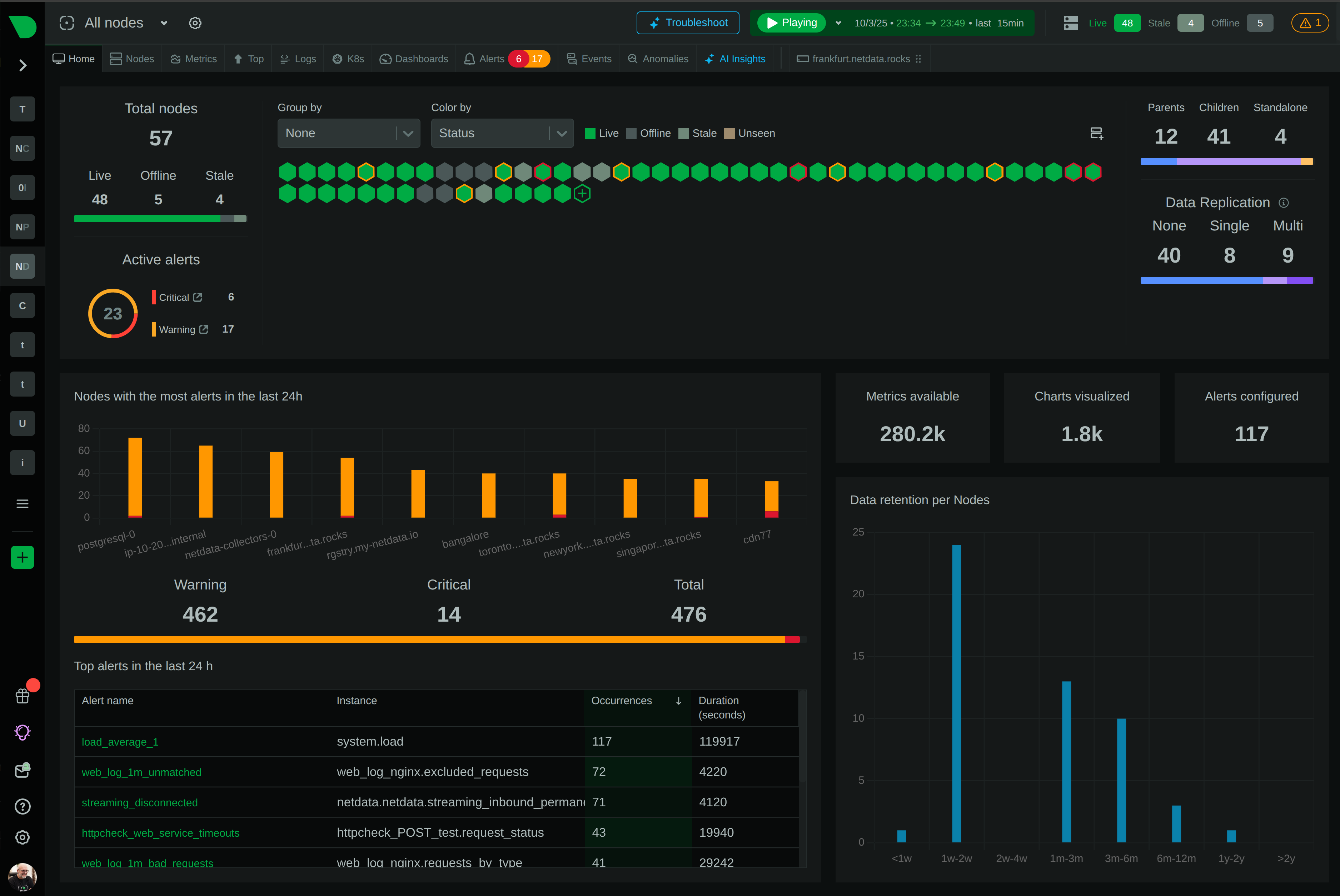
Powerful, intuitive monitoring interface

Modern, responsive UI built for real-time troubleshooting with customizable dashboards and advanced visualization capabilities.

Real-time chart updates
Customizable dashboards
Dark & light themes
Advanced filtering & search
Responsive on all devices
Collaboration features
> Explore Netdata UI

Monitor on the go

Native iOS and Android apps bring full monitoring capabilities to your mobile device with real-time alerts and notifications.

iOS & Android apps
Push notifications
Touch-optimized interface
Offline data access
Biometric authentication
Widget support
> Download apps

The future of infrastructure observability

See our strategic direction across AI-native observability, full-stack signals, operational intelligence, and enterprise platform maturity.

AI-native observability
Full-stack signal coverage
Operational intelligence
Enterprise platform maturity
Agent releases every 6 weeks
Cloud continuous delivery
> Explore Product Roadmap

Best energy efficiency

True real-time per-second

100% automated zero config

Centralized observability

Multi-year retention

High availability built-in

Zero maintenance

Always up-to-date

Enterprise security

Complete data control

Air-gap ready

Compliance certified

Millisecond responsiveness

Infinite zoom & pan

Works on any device

Native performance

Instant alerts

Monitor anywhere

AI-native observability

Continuous delivery

Open source foundation

80% Faster Incident Resolution

AI-powered troubleshooting from detection, to root cause and blast radius identification, to reporting.

True Real-Time and Simple, even at Scale

Linearly and infinitely scalable full-stack observability, that can be deployed even mid-crisis.

90% Cost Reduction, Full Fidelity

Instead of centralizing the data, Netdata distributes the code, eliminating pipelines and complexity.

Control Without Surrender

SOC 2 Type 2 certified with every metric kept on your infrastructure.

Integrations

800+ collectors and notification channels, auto-discovered and ready out of the box.

800+ data collectors
Auto-discovery & zero config
Cloud, infra, app protocols
Notifications out of the box
> Explore integrations
Real Results
46% Cost Reduction

Reduced monitoring costs by 46% while cutting staff overhead by 67%.

— Leonardo Antunez, Codyas

Zero Pipeline

No data shipping. No central storage costs. Query at the edge.

From Our Users
"Out-of-the-Box"

So many out-of-the-box features! I mostly don't have to develop anything.

— Simon Beginn, LANCOM Systems

No Query Language

Point-and-click troubleshooting. No PromQL, no LogQL, no learning curve.

Enterprise Ready
67% Less Staff, 46% Cost Cut

Enterprise efficiency without enterprise complexity—real ROI from day one.

— Leonardo Antunez, Codyas

SOC 2 Type 2 Certified

Zero data egress. Only metadata reaches the cloud. Your metrics stay on your infrastructure.

Full Coverage
800+ Collectors

Auto-discovered and configured. No manual setup required.

Any Notification Channel

Slack, PagerDuty, Teams, email, webhooks—all built-in.

Built for the People Who Get Paged

Because 3am alerts deserve instant answers, not hour-long hunts.

Every Industry Has Rules. We Master Them.

See how healthcare, finance, and government teams cut monitoring costs 90% while staying audit-ready.

Monitor Any Technology. Configure Nothing.

Install the agent. It already knows your stack.
From Our Users
"A Rare Unicorn"

Netdata gives more than you invest in it. A rare unicorn that obeys the Pareto rule.

— Eduard Porquet Mateu, TMB Barcelona

99% Downtime Reduction

Reduced website downtime by 99% and cloud bill by 30% using Netdata alerts.

— Falkland Islands Government

Real Savings
30% Cloud Cost Reduction

Optimized resource allocation based on Netdata alerts cut cloud spending by 30%.

— Falkland Islands Government

46% Cost Cut

Reduced monitoring staff by 67% while cutting operational costs by 46%.

— Codyas

Real Coverage
"Plugin for Everything"

Netdata has agent capacity or a plugin for everything, including Windows and Kubernetes.

— Eduard Porquet Mateu, TMB Barcelona

"Out-of-the-Box"

So many out-of-the-box features! I mostly don't have to develop anything.

— Simon Beginn, LANCOM Systems

Real Speed
Troubleshooting in 30 Seconds

From 2-3 minutes to 30 seconds—instant visibility into any node issue.

— Matthew Artist, Nodecraft

20% Downtime Reduction

20% less downtime and 40% budget optimization from out-of-the-box monitoring.

— Simon Beginn, LANCOM Systems

Pay per Node. Unlimited Everything Else.

One price per node. Unlimited metrics, logs, users, and retention. No per-GB surprises.

Free tier—forever
No metric limits or caps
Retention you control
Cancel anytime
> See pricing plans

What's Your Monitoring Really Costing You?

Most teams overpay by 40-60%. Let's find out why.

Expose hidden metric charges
Calculate tool consolidation
Customers report 30-67% savings
Results in under 60 seconds
> See what you're really paying

Your Infrastructure Is Unique. Let's Talk.

Because monitoring 10 nodes is different from monitoring 10,000.

On-prem & air-gapped deployment
Volume pricing & agreements
Architecture review for your scale
Compliance & security support
> Start a conversation

Monitoring That Sells Itself

Deploy in minutes. Impress clients in hours. Earn recurring revenue for years.

30-second live demos close deals
Zero config = zero support burden
Competitive margins & deal protection
Response in 48 hours
> Apply to partner

Per-Second Metrics at Homelab Prices

Same engine, same dashboards, same ML. Just priced for tinkerers.

Community: Free forever · 5 nodes · non-commercial
Homelab: $90/yr · unlimited nodes · fair usage
> Get the Homelab Plan

$1,000 Per Referral. Unlimited Referrals.

Your colleagues get 10% off. You get 10% commission. Everyone wins.

10% of subscriptions, up to $1,000 each
Track earnings inside Netdata Cloud
PayPal/Venmo payouts in 3-4 weeks
No caps, no complexity
> Get your referral link
Cost Proof
40% Budget Optimization

"Netdata's significant positive impact" — LANCOM Systems

Calculate Your Savings

Compare vs Datadog, Grafana, Dynatrace

Savings Proof
46% Cost Reduction

"Cut costs by 46%, staff by 67%" — Codyas

30% Cloud Bill Savings

"Reduced cloud bill by 30%" — Falkland Islands Gov

Enterprise Proof
"Better Than Combined Alternatives"

"Better observability with Netdata than combining other tools." — TMB Barcelona

Real Engineers, <24h Response

DPA, SLAs, on-prem, volume pricing

Why Partners Win
Demo Live Infrastructure

One command, 30 seconds, real data—no sandbox needed

Zero Tickets, High Margins

Auto-config + per-node pricing = predictable profit

Homelab Ready
Free Video Course

8-episode Netdata tutorial by LearnLinux.tv

76k+ GitHub Stars

3rd most starred monitoring project

Worth Recommending
Product That Delivers

Customers report 40-67% cost cuts, 99% downtime reduction

Zero Risk to Your Rep

Free tier lets them try before they buy

AI Support Assistant, Available 24/7

Nedi has access to all official documentation, source code, and resources. Ask any question about Netdata—responds in your language.

Deployment & configuration
Troubleshooting & sizing
Alerts & notifications
Evidence-based answers
> Ask Nedi now

Never Fight Fires Alone

Docs, community, and expert help—pick your path to resolution.

Learn.netdata.cloud docs
Discord, Forums, GitHub
Premium support available
> Get answers now

60 Seconds to First Dashboard

One command to install. Zero config. 850+ integrations documented.

Linux, Windows, K8s, Docker
Auto-discovers your stack
> Read our documentation

Level Up Your Monitoring

Real problems. Real solutions. 112+ guides from basic monitoring to AI observability.

76,000+ Engineers Strong

615+ contributors. 1.5M daily downloads. One mission: simplify observability.

Per-Second. 90% Cheaper. Data Stays Home.

Side-by-side comparisons: costs, real-time granularity, and data sovereignty for every major tool.

See why teams switch from Datadog, Prometheus, Grafana, and more.

> Browse all comparisons
Edge-Native Observability, Born Open Source
Per-second visibility, ML on every metric, and data that never leaves your infrastructure.
Founded in 2016
615+ contributors worldwide
Remote-first, engineering-driven
Open source first
> Read our story
Promises We Publish—and Prove
12 principles backed by open code, independent validation, and measurable outcomes.
Open source, peer-reviewed
Zero config, instant value
Data sovereignty by design
Aligned pricing, no surprises
> See all 12 principles
Edge-Native, AI-Ready, 100% Open
76k+ stars. Full ML, AI, and automation—GPLv3+, not premium add-ons.
76,000+ GitHub stars
GPLv3+ licensed forever
ML on every metric, included
Zero vendor lock-in
> Explore our open source
Build Real-Time Observability for the World
Remote-first team shipping per-second monitoring with ML on every metric.
Remote-first, fully distributed
Open source (76k+ stars)
Challenging technical problems
Your code on millions of systems
> See open roles
Meet the Team Behind Netdata
Conferences, meetups, and tradeshows where you can see Netdata in action and talk to the engineers who build it.
Live demos and deep dives
Book 1-on-1 meetings
Talks and panel sessions
Event recaps and photos
> See all events
Talk to a Netdata Human in <24 Hours
Sales, partnerships, press, or professional services—real engineers, fast answers.
Discuss your observability needs
Pricing and volume discounts
Partnership opportunities
Media and press inquiries
> Book a conversation
Your Data. Your Rules.
On-prem data, cloud control plane, transparent terms.
Trust & Scale
76,000+ GitHub Stars

One of the most popular open-source monitoring projects

SOC 2 Type 2 Certified

Enterprise-grade security and compliance

Data Sovereignty

Your metrics stay on your infrastructure

Validated
University of Amsterdam

"Most energy-efficient monitoring solution" — ICSOC 2023, peer-reviewed

ADASTEC (Autonomous Driving)

"Doesn't miss alerts—mission-critical trust for safety software"

Community Stats
615+ Contributors

Global community improving monitoring for everyone

1.5M+ Downloads/Day

Trusted by teams worldwide

GPLv3+ Licensed

Free forever, fully open source agent

Why Join?
Remote-First

Work from anywhere, async-friendly culture

Impact at Scale

Your work helps millions of systems

Generic JSON-over-HTTP IPAM icon

Generic JSON-over-HTTP IPAM

Generic JSON-over-HTTP IPAM

Plugin: netflow-plugin Module: generic-ipam

Overview

Annotate network flows with network-identity labels from any JSON-over-HTTP IPAM or CMDB endpoint. The plugin does not care WHO produces the JSON – it cares about the JSON shape after your transform (a jq expression) runs over it. Examples: Infoblox WAPI, BlueCat REST API, phpIPAM, ServiceNow CMDB queries, an internal aggregator, a Lambda function, a static file served from S3, a hand-rolled CMDB.

This card is also the reference description of how all the other Network Identity cards work under the hood. AWS IP Ranges, GCP IP Ranges, Azure IP Ranges and NetBox are all special-cased instances of this same mechanism: each is just a known URL plus a recommended jq transform. Read this card to understand the generic shape, then read the per-source cards for the URL and transform that fit that specific provider.

For the full network-identity concept (merge order vs GeoIP and static, what fields you can populate, why TLS verification cannot be disabled), see Network Identity.

The plugin issues a periodic HTTP request (GET by default, POST optionally) to your configured URL with the headers you specify, parses the response as JSON, runs your transform jq expression (compiled by the jaq library) over the parsed body, and merges the resulting per-prefix rows into the network-attributes trie.

The same flow applies to every JSON-over-HTTP source; the integration-specific part is the URL and the transform expression.

This integration is only supported on the following platforms:

  • Linux

This integration supports multiple instances configured side-by-side.

Default Behavior

Auto-Detection

Disabled by default. Add a named entry under enrichment.network_sources for each IPAM/CMDB/endpoint you want to import.

Limits

Resource use scales with response size, transform complexity, refresh interval, and the number of emitted prefixes. Empty transform output is treated as a fetch failure.

Performance Impact

One HTTP request per refresh interval plus a jq transform over the response. Runtime enrichment does prefix matching for source and destination IPs, and cost scales with the number of loaded network-source records.

Setup

Prerequisites

An HTTP/HTTPS endpoint returning JSON

The endpoint must respond with a parseable JSON document (the plugin sets Accept: application/json). Only GET and POST are accepted as request methods. There is no pagination, no cursor following, no Link: rel=next handling – the fetch is one-shot per cycle. If your IPAM paginates, expose a bulk endpoint or wrap it in a server-side aggregator that returns the full list at one URL.

Authentication via headers

The plugin has no built-in OAuth flow, basic-auth helper, or token refresh. Whatever the API needs (bearer tokens, API keys, custom header names, basic-auth realms) goes into the headers: map. The header map is an arbitrary string-to-string mapping, so any single-shot scheme works. For short-lived tokens, refresh them outside Netdata and reload the plugin config.

A POST endpoint must accept an empty body

When method: POST is configured, the plugin sends the request with the configured headers but no request body. If your CMDB requires a JSON query body to return prefixes, wrap it server-side with an endpoint that accepts GET (or POST with no body) and returns the full prefix set.

Configuration

Options

Add a named entry under enrichment.network_sources. Unknown keys cause a config error.

OptionDescriptionDefaultRequired
urlHTTP/HTTPS endpoint. Required (a non-empty URL is enforced by validation).yes
methodHTTP method. Only GET and POST are accepted; anything else fails validation. Note that POST is sent with no request body.GETno
headersMap of additional HTTP request headers. Use this for any authentication scheme (Authorization: Bearer ..., token: ..., custom API-key headers, basic-auth realms encoded explicitly, etc.). Values are passed through verbatim.{}no
intervalRefresh cadence. Values below 60 seconds are accepted, but refreshes still run no faster than once per minute. Pick the value that matches how often your IPAM actually changes (5-15 minutes for a curated CMDB; daily for slow-moving prefix lists).60sno
timeoutPer-request timeout. Must be greater than 0.60sno
proxyWhether to honor the system HTTP/HTTPS proxy environment variables. Set to false to bypass the proxy for this source (useful when the IPAM is on the internal network and the proxy is for outbound traffic only).trueno
tls.enableEnables custom TLS settings (custom CA bundle, mTLS client certificate). Must be true whenever any of tls.ca_file, tls.cert_file, tls.key_file is set.falseno
tls.verifyCertificate verification toggle. Setting this to false is rejected by validation – network-identity data flows directly into security-relevant enrichment, so MITM-able responses are not allowed. Use tls.ca_file to trust internal CAs instead.trueno
tls.skip_verifyLegacy alias for the same intent as tls.verify: false. Setting this to true is rejected by validation. Use tls.ca_file.falseno
tls.ca_filePEM file with the CA bundle to trust for this endpoint (instead of, or in addition to, the system roots). The recommended way to talk to an internal IPAM behind your own PKI.no
tls.cert_filePEM file with the client certificate, for mTLS-protected endpoints.no
tls.key_filePEM file with the client private key. Required only when the key is in a separate file from the certificate; if omitted, the cert file is reused. tls.cert_file must also be set whenever tls.key_file is set.no
transformjq expression compiled by jaq. Receives the entire parsed JSON body once and must produce a stream of objects, where each object has at minimum a prefix field (a CIDR string – IPv4/len or IPv6/len) plus any of the optional attribute fields: name, role, site, region, country, state, city, tenant, asn, asn_name. Any field not produced is treated as empty. The transform compiles at startup – a syntax error fails the config load. An empty stream at runtime is treated as a fetch failure and triggers backoff..yes

via File

The configuration file name for this integration is netflow.yaml.

You can edit the configuration file using the edit-config script from the Netdata config directory.

cd /etc/netdata 2>/dev/null || cd /opt/netdata/etc/netdata
sudo ./edit-config netflow.yaml
Examples
Flat list with {prefix, name, env}

The simplest IPAM shape: a top-level array of subnets, each with a CIDR string and a few labels. Maps env -> tenant and the name -> NET_NAME.

enrichment:
  network_sources:
    custom_ipam:
      url: "https://ipam.corp.example/api/v1/prefixes"
      headers:
        Authorization: "Bearer abcdef0123456789"
      interval: 5m
      transform: |
        .[] | {
          prefix: .prefix,
          name: .name,
          tenant: .env
        }        
phpIPAM with API token

phpIPAM exposes /api/<APP>/subnets/. Replace <APP> with your phpIPAM application name. phpIPAM splits the address into a base and a mask – the transform reassembles them into a CIDR string.

enrichment:
  network_sources:
    phpipam:
      url: "https://ipam.example/api/netdata/subnets/"
      headers:
        token: "abcdef..."
      interval: 10m
      transform: |
        .data[] | {
          prefix: (.subnet + "/" + (.mask|tostring)),
          name: .description,
          tenant: (.custom_tenant // ""),
          site: (.location.name // "")
        }        
Hierarchical CMDB export

A CMDB that returns nested objects – top-level sites, each with a list of vlans, each with a list of prefixes. Flattens to one row per prefix, inheriting site and role labels from the parent.

enrichment:
  network_sources:
    cmdb:
      url: "https://cmdb.example/export/networks.json"
      headers:
        Authorization: "Bearer <CMDB_TOKEN>"
      interval: 15m
      transform: |
        .sites[] as $site
        | $site.vlans[] as $vlan
        | $vlan.prefixes[]
        | {
            prefix: .cidr,
            name: .label,
            site: $site.name,
            region: $site.region,
            role: $vlan.role,
            tenant: $vlan.tenant
          }        
Internal IPAM behind mTLS

When the IPAM is fronted by your internal PKI and requires a client certificate. tls.enable: true activates the custom TLS path; tls.verify must remain true (cannot be disabled).

enrichment:
  network_sources:
    corp_ipam:
      url: "https://ipam.corp/api/networks"
      tls:
        enable: true
        ca_file: /etc/netdata/ssl/corp-ca.pem
        cert_file: /etc/netdata/ssl/netdata.crt
        key_file: /etc/netdata/ssl/netdata.key
      interval: 10m
      transform: |
        .[] | {
          prefix: .cidr,
          name: .label,
          tenant: .tenant
        }        
Source with the system proxy bypassed

When the agent host has an outbound HTTP proxy configured but the IPAM lives on the internal network and should be reached directly.

enrichment:
  network_sources:
    internal_ipam:
      url: "https://ipam.internal/api/networks"
      proxy: false
      headers:
        Authorization: "Bearer ..."
      interval: 5m
      transform: |
        .[] | { prefix: .cidr, name: .label }        

Metrics

Tags flow records with whatever labels your jq transform emits – typically *_NET_NAME, *_NET_TENANT, *_NET_SITE, *_NET_ROLE, *_NET_REGION. Verify on the Network Flows view via the *_NET_* columns.

Alerts

There are no alerts configured by default for this integration.

Endpoint requires pagination

The plugin does not paginate. Either raise the page size in the URL to cover your full inventory, or wrap the endpoint with a server-side aggregator that returns all results at one URL. There is no built-in Link: rel=next follower.

POST endpoint requires a request body

The plugin’s POST request is sent with no body. If your CMDB requires a JSON query body to return prefixes, wrap it server-side with an endpoint that accepts GET (or accepts POST with no body) and returns the full prefix set.

TLS verification cannot be disabled

tls.verify: false and tls.skip_verify: true are both rejected during configuration validation. Use tls.ca_file to trust internal CAs. This is deliberate – network-identity rows feed enrichment used in security investigations and capacity decisions, where silently accepting MITM-able responses would corrupt every downstream analysis.

Empty result back-off

An empty stream from the jq transform is treated as a fetch failure. The source then backs off exponentially – starting at interval / 10 (floor 1s), doubling on each consecutive failure, and capped at the regular interval. On the next successful non-empty fetch the cadence resets to interval. If your IPAM legitimately has no prefixes (a quiet state), have the upstream return at least one synthetic prefix so the source does not back off.

Refresh appears slower than configured

The fetch loop floors the configured interval at 60 seconds. Configuring interval: 5s does not produce a 5-second loop – it produces a 60-second loop. Pick a value at or above 60s that matches how often your IPAM actually changes (5-15 minutes is typical for a curated CMDB).

Unknown config keys cause errors

The config struct uses deny_unknown_fields. Typos like headres: or a non-existent option fail config load with a parse error rather than being silently ignored. Check the enrichment.network_sources.<name> schema listed under “Config options”.

JSON parse errors are silent in the dashboard

Decode failures (HTTP error, JSON parse error, jq runtime error, schema mismatch on prefix) are logged but do not surface in the dashboard. Watch the Netdata journal for warnings: journalctl --namespace netdata | grep network_sources.

Prefer explicit authorization headers over URL credentials

URLs with embedded credentials (https://user:pass@host) are converted to HTTP Basic authentication by the HTTP client. Prefer headers: for clarity and to avoid storing credentials in URLs – e.g. headers: { Authorization: "Basic dXNlcjpwYXNz" } for HTTP basic-auth.

The observability platform companies need to succeed

Sign up for free

Want a personalised demo of Netdata for your use case?

Contact Sales